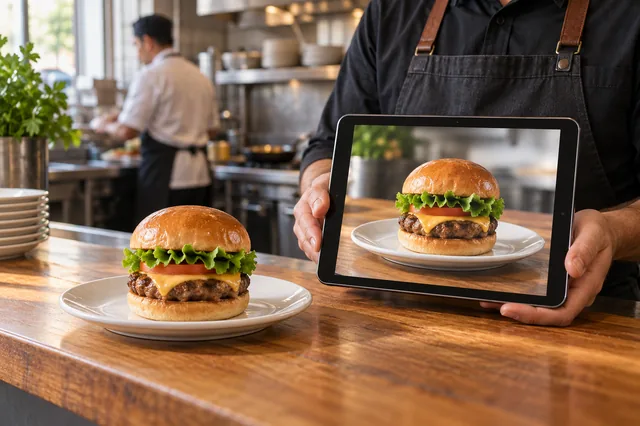
If you run a restaurant in the EU, or you advertise to guests there, the way you label an AI-generated food photo stopped being a style question in 2026. Article 50 of the AI Act introduced transparency obligations that apply from 2 August 2026, and the European Commission adopted guidelines on their scope on 20 July 2026. Most coverage so far has been written for software vendors and law firms. This is the operator version, limited to the photos on your menu, your delivery listings and your ads.
Nothing here is legal advice. It is a practical reading of the published rules, followed by the workflow changes they imply for a restaurant kitchen.
What changed on 2 August 2026
Article 50 covers four situations. Two of them touch a restaurant photo workflow.
- Deployers of a system that generates or manipulates image, audio or video content that is a deep fake must disclose that the content was artificially generated or manipulated.
- Deployers of a system that generates or manipulates text published to inform the public on matters of public interest must disclose that the text was artificially generated, unless a person exercised human review or editorial control and takes responsibility for the publication.
The Commission guidelines explain the scope and the exemptions. A voluntary Code of Practice on Transparency of AI-generated Content offers a structured way to demonstrate compliance, and the EU published a set of icons that deployers may use to label AI-generated content. The code is voluntary. The obligations are not, whether or not a business signs it. Cooley reported that noncompliance can trigger fines of up to 15 million euro or 3 percent of worldwide annual turnover, whichever is higher.
Two transitional details matter. Content published before 2 August 2026 does not need retroactive labels. The four month transition, until 2 December 2026, applies only to the provider-side machine readable marking obligation for generative systems already on the market before 2 August. Deployer disclosure duties are live now.
Does an enhanced dish photo count as a deep fake
Every restaurant will ask this, and the answer depends on what came out of the tool. The distinction is practical rather than philosophical.
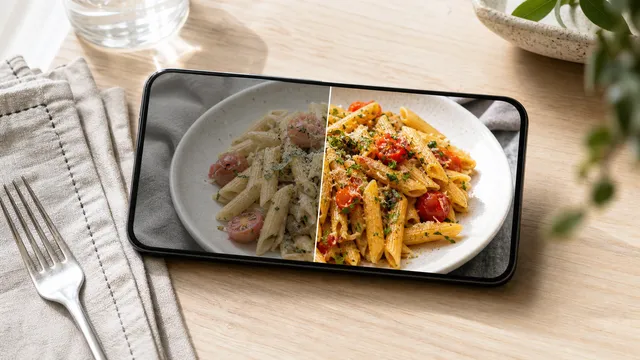
An AI enhancement of a real photo of a dish you serve, where the tool corrected exposure, white balance, crop or background and left the ingredients, portion and plating recognisable, is a normal edited photograph. It is not pretending to be something that never existed, and it sits in the same family as retouching that predates AI.
An image where the tool invented the dish, added ingredients that were not on the plate, enlarged the portion, or staged a scene that was never served is a synthetic depiction. That is where disclosure matters most, and it is also where restaurants get into trouble with delivery platforms and guests, independent of the AI Act.
Article 50 contains an exemption for content that forms part of an evidently artistic, creative, satirical, fictional or analogous work. A deliberately stylised campaign image can fall inside that space. A menu listing that shows a dish a guest will order does not read as artistic commentary, so do not lean on the exemption for menu photography.
Who counts as a deployer
Article 50 puts duties on providers of AI systems and on deployers, which means the organisation that uses the system in a professional context. A restaurant using an AI photo tool to publish marketing content is a deployer in the ordinary sense of the term. You are not expected to mark the file at the model level, which is the provider's job. You are expected to disclose when the published content falls into one of the covered categories.
This has a practical consequence for agencies and freelancers. If you work with a marketing partner, agree in writing who records what the tool did and who applies the label. The duty follows the publication, and publications are often scheduled by someone who was not in the kitchen.
A working policy for restaurant photos
Pick one rule and write it down so the kitchen and the marketing person apply the same standard: AI improves presentation, never the food. Then extend it with the disclosure practice below.
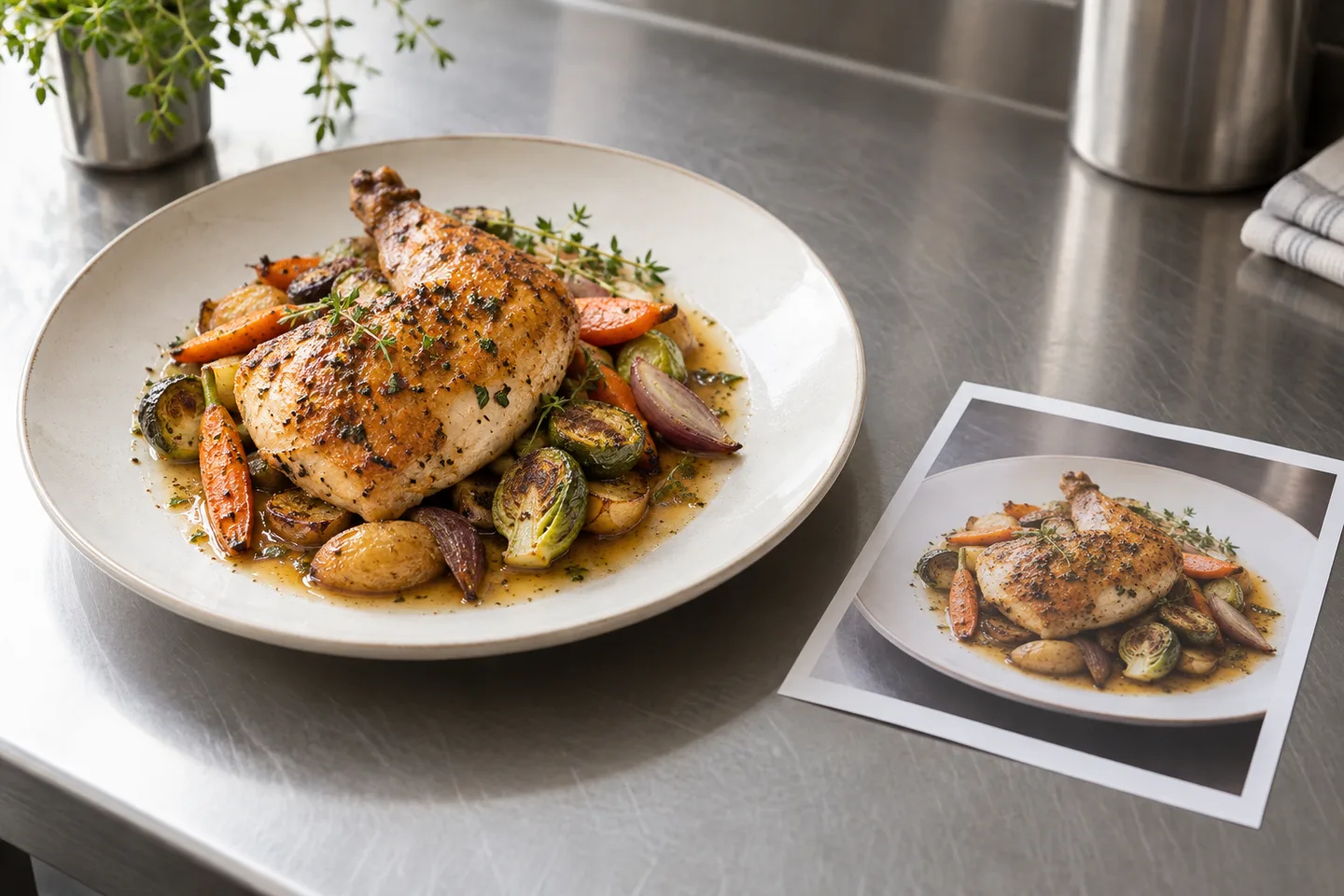
- Keep the original phone photo for every published image. Store it beside the final file with a stable name, for example dishname_original.jpg next to dishname_menu-v2.jpg.
- Record what the tool did. A one line note is enough, such as "corrected white balance, cleaned background, kept portion".
- Label synthetic dishes. If the image is generated rather than enhanced, say so in the caption or the alt text, and do not present it as a menu item you sell.
- Keep labels out of the plate. Write the disclosure in the page caption, alt text or an adjacent line. Burned in text also breaks most delivery platform content rules, which reject images containing words.
- Approve against the original. One named person compares the finished image with the original photo before anything goes live.
- Log the tool and date for each published image, so an audit six months later does not depend on memory.
How to write a disclosure that reads well
A disclosure can be short and still clear. Put it where the reader already looks for context: the caption under the image, the alt text, or a line in the menu footer. Three patterns cover most cases.
| Case | Example line |
|---|---|
| Enhanced real dish | Photo edited for light and crop. The dish is the one served. |
| Generated dish image used as illustration | Generated illustration. Not a photograph of our dish. |
| Generated image in a campaign | Visual created with AI for this campaign. |
Avoid hedging that says nothing, such as "AI-assisted" next to a dish that was invented. Say what the image is.
Where the risk concentrates
| Situation | Risk level | What to do |
|---|---|---|
| Lighting, crop and background cleanup on a real dish | Low | Keep the original, note the edit, publish. |
| Recreating the same dish from an old photo for a new menu | Low if the recipe is unchanged | Confirm the portion and ingredients still match service. |
| Generating a dish you do not serve as decoration | High | Label it as generated, or remove it from sales pages. |
| Generating a promotional image with invented prices or offers | High | Use only supplied prices and offers, or leave the space blank. |
| Publishing AI text about health, allergens or nutrition as fact | High | Have a person review it and attribute it, or do not publish it. |
| An image that shows a dish in a portion you do not serve | High | Re-shoot. A disclosure does not fix a misleading portion. |
What to do with the library you already have
Published content from before 2 August 2026 does not need retroactive labelling. That does not mean the old catalogue is safe in every respect. A photo that no longer matches the dish is a consumer trust problem regardless of the AI Act. Use the deadline pressure as a reason to run the photo to plate check on your top sellers. Replace the images that no longer match, and keep the rest.
A ten point disclosure checklist
- Originals archived and linked to every published file.
- A short edit note stored with the final image.
- Synthetic images marked in the caption or alt text.
- No AI logo or wordmark burned into the image.
- No invented ingredients, portions, prices or claims.
- One approver named and trained.
- Delivery listings carry accurate, single item photos.
- Menu text published as crawlable HTML, with the image as support.
- Content published before 2 August 2026 left as it is.
- Policy reviewed again before 2 December 2026, when the provider marking transition ends.
FAQ
Do I need to label every AI-enhanced food photo
No. The disclosure duty attaches to deep fakes, to certain public interest text, and to the marking rules that sit with providers. A straightforward enhancement of a real dish photo is ordinary retouching. Generated dishes and invented scenes should be labelled.
Are the EU icons mandatory
They are not. The Commission published icons that deployers may use, and they sit alongside the voluntary code. You still decide how to make the disclosure clear and visible.
What about photos published before August 2026
They do not need retroactive labelling. New uploads and new campaigns fall under the rules as they stand now.
Does this apply outside the EU
The AI Act has extraterritorial reach for providers and deployers whose output reaches the EU market. If you advertise to EU guests, assume it can apply and check with counsel for your situation.
We use a generator, not an enhancer. Is that different
Yes. A generated dish is the category that most needs a visible label, and it also tends to fail delivery platform content rules and guest expectations. Keep generated images for clearly illustrative use.
Where FoodPhoto fits
The studio is built around enhancement of a real dish photo. You start from a photo of the plate you serve, keep the portion and ingredients, and review the result against the original before it goes anywhere. That gives you the original, the edit note and the approval step that a disclosure policy needs. You can open the studio and try it on one dish, then use our restaurant AI photo policy template for the internal rule.
Sources: European Commission, code of practice on transparency of AI-generated content, Article 50 of the EU AI Act, transparency obligations, European Commission, guidelines on transparency obligations