A recurring photographer is a great service and a real expense. For most restaurants the math stops working when you realize how often you actually need new images — every special, every seasonal swap, every new dish, every delivery platform that wants a fresh crop. Replacing the restaurant photographer with an in-house phone plus AI food photography system doesn’t mean lower quality; it means owning the high-frequency work yourself and reserving a pro for the rare moments that truly need one.
This is the honest version: what the in-house system does well, what it costs, and where a photographer still wins.
The real reason the old model breaks
A traditional shoot is a snapshot in time. You pay for a session, get a batch of images, and then your menu keeps moving. Within a quarter you’ve added items, changed plating, and launched specials the shoot never covered. You either pay again or let the gaps fill with weak phone snaps. The problem was never the photographer’s quality — it was the frequency mismatch between a once-a-quarter shoot and a menu that changes every week.
An in-house system closes that gap. You capture dishes the day they exist and publish them clean, on-brand, and consistently.
The in-house system in four parts
1. A repeatable capture setup
You don’t need a studio. You need a consistent corner:
- A recent phone (flash off, main lens, full resolution).
- One soft light source — a window with indirect light, or a daylight LED panel.
- A white foam board to fill shadows.
- A clean, neutral surface and a fixed shooting angle.
Lock those variables and every photo starts from the same baseline. Our phone food photography guide covers the capture details step by step.
2. A shot list, not a vibe
Decide before you shoot. Each week, list the three to five dishes that need images — new items, specials, and bestsellers with weak photos. Shoot 10-15 frames per dish, vary the angle slightly, and move on.
3. AI enhancement for the finish
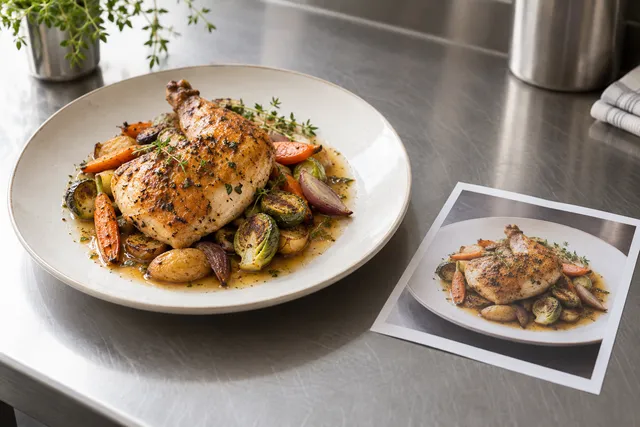
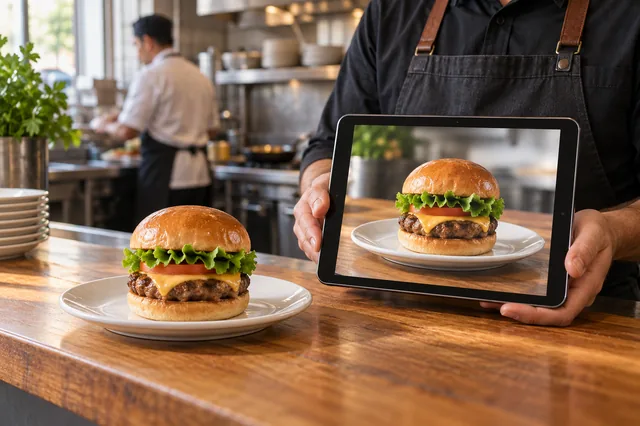
This is the part that used to require the photographer’s editing skill. Upload your phone shot to FoodPhoto.ai and it fixes lighting, cleans the background, balances color, restores gloss, and crops to spec — without changing the food. That last point matters: it’s honest enhancement of the real dish, not a generated image, so what’s on the listing is what lands at the door. FoodPhoto begins with two previews on your own dish, with a verified account and no card. Free previews are significantly slower than paid plans and are prepared in a separate queue: about 30–35 seconds in normal conditions, and longer when the service is busy or the edit is complex. Keep the chat open and do not repeat the request while it processes. See the current plans and usage estimates for photos, menus and campaigns.
4. A publish routine
Export the crops each channel needs and push them out: menu, delivery apps, Google Business Profile, social. For multi-channel sizing without rework, see the cross-platform delivery photo checklist.
The cost comparison
| Approach | Cost per finished image | Cadence | Best for |
|---|---|---|---|
| Professional shoot | $20-$80 (often $300-$2,000+/session) | Once or twice a year | Hero brand, environmental, campaigns |
| Freelance per-dish | $15-$40 | On demand, scheduling overhead | Occasional gaps |
| In-house phone + AI | ~$0.14-$0.60 | Weekly, on your schedule | Menu, delivery, social, specials |
A full menu refresh through AI enhancement costs less than a single studio dish. The savings aren’t the headline, though — the cadence is. You stop rationing images and start treating photos like a routine kitchen task.
A realistic weekly loop
- Plan (15 min): pick this week’s dishes and the channels that need updates.
- Shoot (45-60 min): set the light, plate clean, capture each dish.
- Enhance (20-30 min): run shots through FoodPhoto.ai for a consistent look.
- Publish (15 min): export crops and update every channel.
One person, about 90 minutes, and your visuals never go stale.
What you actually gain by owning the workflow
The cost savings are obvious, but the operational wins are what change how the business runs:
- Same-day specials get photos. A Tuesday special that sells out by Thursday finally has a real image, not a gap.
- Delivery listings stay current. When DoorDash or Uber Eats wants a fresh crop or a new item shot, you produce it in minutes instead of waiting for the next scheduled session.
- No coordination tax. No scheduling around the photographer’s calendar, no day of kitchen disruption, no "we’ll get those edited next week."
- A consistent look you control. Because the same person uses the same setup and the same enhancement standard, the menu reads as one brand instead of a patchwork of sessions shot months apart.
The shift is from photography as a project to photography as a routine — like prepping or ordering stock.
A 30-day transition plan
Don’t rip out the old model overnight. Phase it in:
- Week 1 — Build the station. Pick the corner, the light, the surface, and the angle.
- Week 2 — Run a parallel shoot. Photograph your next batch of specials in-house and keep your existing listings. Compare side by side.
- Week 3 — Replace the weak links. Swap your worst-performing menu and delivery photos with enhanced in-house shots first; that’s where the lift is biggest.
- Week 4 — Lock the loop. Put the weekly 90-minute session on the schedule and assign one owner. Reserve the photographer’s budget for the brand layer only.
By the end of the month you have a repeatable system and a clear, smaller line item for the photographer that’s tied to genuine brand work, not routine refreshes.
Where a photographer still earns the fee
This isn’t an anti-photographer argument. Be honest about the line:
- Hero and brand imagery: a signature shot for the homepage, packaging, or a campaign benefits from real art direction.
- Environmental and team photos: the room, the staff, the energy — that’s human work.
- One-time launches where a distinctive creative concept is the point.
Hire the pro for those. Run everything high-frequency in-house. Many operators land here: a photographer once or twice a year for the brand layer, and an AI workflow for the relentless weekly demand.
Keeping it consistent across a team
If more than one person shoots, give them the same shot list, the same surface, and the same enhancement settings. Consistency is what makes a self-shot menu look professionally produced. For multi-brand or multi-location operations, our ghost kitchen weekly system shows how to keep several menus on a single style without constant shoots.
The honest bottom line
You can replace the recurring photographer with a system you control, and you should — the frequency math demands it. Keep a pro for the rare brand-defining work, and let an in-house phone plus AI loop handle the rest, cleanly and consistently.
Start small: shoot one dish, run it through the FoodPhoto.ai, and compare it to your current listing.
Frequently Asked Questions
Can AI food photography really replace a restaurant photographer?
For most ongoing menu, delivery-app, and social photos, yes. A phone plus AI enhancement covers the high-volume, high-frequency work at a fraction of the cost. A photographer still earns their fee for hero brand shoots, environmental and team photography, and one-time campaigns where art direction matters.
How much does an in-house AI photo system cost vs a photographer?
Does AI food photography fake the food?
Good tools don’t. FoodPhoto.ai enhances the real photo of your real dish — fixing lighting, background, color, gloss, and crop without changing the food itself. It’s honest enhancement, not text-to-image fabrication, so the listing matches what arrives.
What do I need to run this in-house?
A recent phone, a window or one LED panel, a clean surface, and an AI enhancement tool. One person can shoot and publish a week of menu photos in about 90 minutes.
Related guides
- Food photography costs, every option ranked
- The real payback of refreshing photos
- The shoot – enhance – publish SOP
Ready to upgrade your menu photos? Open the FoodPhoto.ai studio or see plans and pricing.